

Orthotics for diabetic foot care are among the most medically important — and most frequently underused — tools available to people managing diabetes. With more than 37 million Americans living with diabetes, according to the Centers for Disease Control and Prevention, foot complications remain one of the leading causes of hospitalization, disability, and amputation in this population — yet the majority are preventable with the right protective footwear and custom orthotic support.
This guide covers everything you need to know: why diabetic feet are uniquely vulnerable, how custom orthotics work, what distinguishes them from standard diabetic shoes and generic inserts, which materials and designs perform best, how to get fitted, what insurance covers, and how to choose a provider who delivers genuine clinical-grade protection — not just a retail product.
What Are Orthotics for Diabetic Foot Care?
Orthotics for diabetic foot care are custom-fabricated or specially engineered shoe inserts designed to redistribute plantar pressure, cushion at-risk areas, reduce friction, and protect feet that have been compromised by the effects of diabetes. Unlike generic pharmacy insoles, diabetic orthotics are built around the specific vulnerabilities that the disease creates — most critically, peripheral neuropathy and impaired circulation.
Diabetic neuropathy — nerve damage caused by prolonged elevated blood glucose — progressively diminishes the ability to feel pain in the feet. As a result, small pressure points, blisters, friction sores, and cuts often go completely unnoticed until they have become open wounds. Simultaneously, peripheral arterial disease reduces blood flow, impairing the body's ability to heal even minor injuries. Together, these two factors create conditions where a small blister can escalate into a deep infection, and an unmanaged ulcer can lead to amputation.
This is why protective orthotics for diabetic foot care are not a comfort upgrade — they are a clinical necessity that directly reduces the risk of life-altering complications.
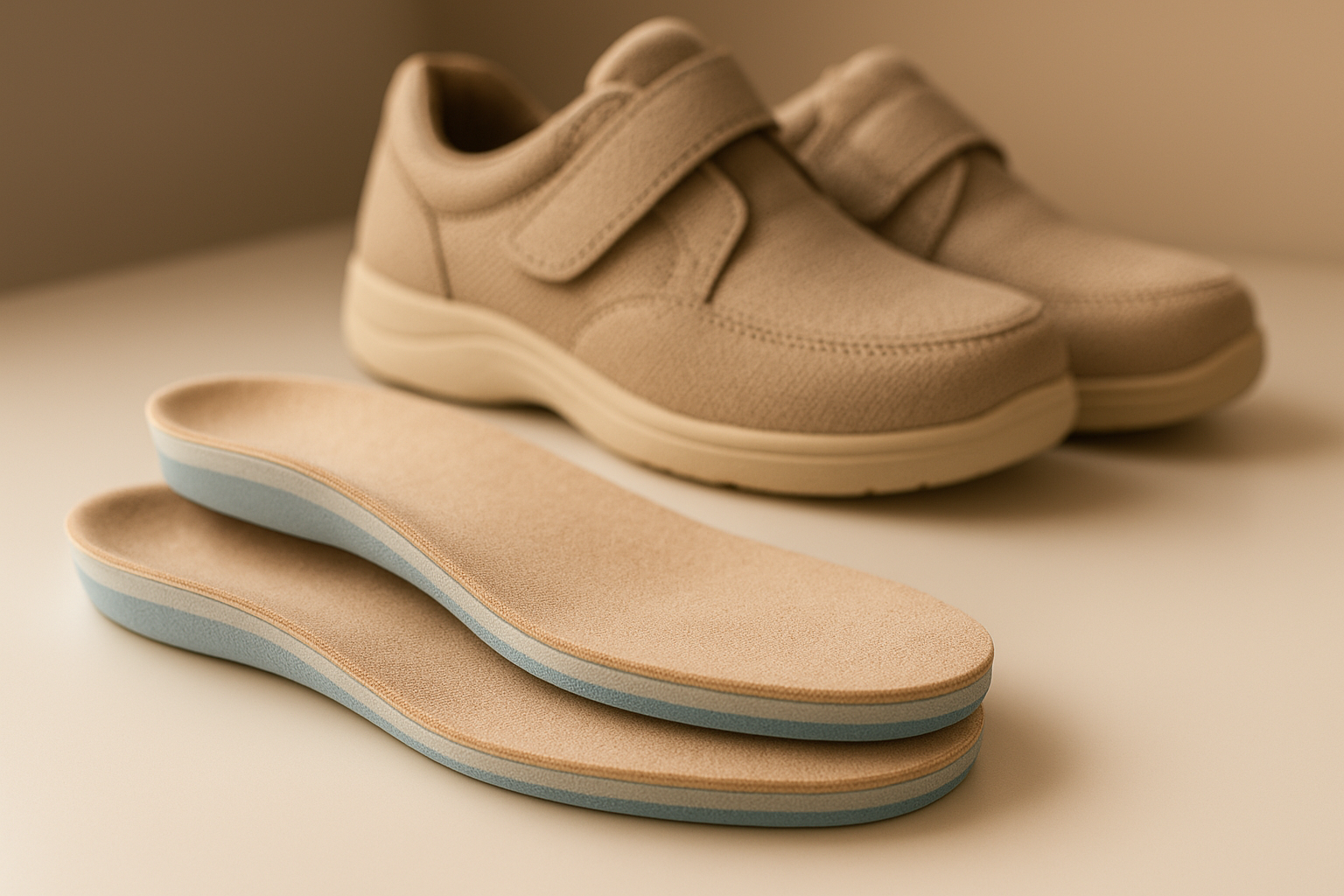
Custom orthotics for diabetic foot care use specialized multi-layer cushioning to protect sensitive feet from pressure, shear, and friction damage.
Why Diabetes Makes Foot Care So Critical
Diabetes creates a compounding set of problems in the lower limbs that worsen over time if blood sugar remains poorly controlled. High glucose levels damage both the small blood vessels that supply the feet and the peripheral nerves that carry sensation. The result is a foot that cannot feel injury and cannot heal efficiently — a dangerous combination.
According to the American Diabetes Association, approximately 15% of people with diabetes will develop a foot ulcer at some point during their lifetime. Of those who develop infected ulcers, up to 20% will require amputation. In the United States, diabetes accounts for more than 60% of all non-traumatic lower limb amputations — yet the majority of these outcomes are preventable with proactive footwear intervention.
Beyond neuropathy and circulation issues, diabetes also directly alters the structural architecture of the foot over time:
- Charcot foot (Charcot neuroarthropathy) — a severe condition where weakened bones in the foot collapse and fracture due to loss of protective sensation, causing progressive deformity
- Hammertoes and claw toes — motor neuropathy weakens the intrinsic foot muscles, causing toe contractures that create new bony pressure points
- Plantar fat pad atrophy — the natural cushioning layer under the metatarsal heads thins with age and disease, increasing forefoot pressure
- Flat arches and collapsed arch structure — contribute to abnormal gait and concentrated loading across the sole
- Bunions and hallux valgus — create medial bony prominences that rub against footwear and lead to ulceration
Each of these structural changes raises the stakes for getting footwear and orthotic support exactly right.
Common Foot Problems Orthotics for Diabetic Foot Care Can Address
A properly prescribed pair of custom diabetic orthotics can directly manage or mitigate a broad range of complications, including:
- Elevated plantar pressure and ulcer prevention at the forefoot, heel, and midfoot
- Neuropathic pain, burning, and discomfort resulting from peripheral nerve damage
- Charcot foot offloading and structural bracing support
- Hammertoe and digital deformity accommodation to prevent dorsal toe ulcers
- Heel pain and plantar fasciitis — disproportionately common in diabetic patients
- Metatarsalgia and forefoot callus formation over pressure-loaded metatarsal heads
- Flat arches and overpronation that place asymmetric stress across the foot
- Post-amputation foot rebalancing for patients who have lost toes or partial forefoot
You can explore a broader look at what foot problems custom orthotics can help with to see how these devices address conditions well beyond diabetes alone.
Diabetic Shoes vs. Custom Orthotics: Understanding the Difference
Many patients and even some clinicians conflate diabetic shoes with diabetic orthotics — but they are distinct products that serve complementary, not interchangeable, roles. Understanding the difference is essential to building an effective diabetic foot protection system.
What Diabetic Shoes Do
Diabetic shoes (also called therapeutic shoes or depth shoes) are designed with a broader toe box, extra depth, seamless interiors, and soft, non-irritating linings. Their primary function is to eliminate external friction, prevent toe compression, and reduce internal rubbing that can cause blisters or irritation. They provide the container — a safe, accommodating environment for the foot.
However, diabetic shoes alone do not control what happens to the bottom of the foot. They do not redistribute plantar pressure or provide targeted offloading of high-risk zones like the first metatarsal head, heel, or a Charcot collapse site. That is the role of the orthotic insert placed inside.
What Custom Diabetic Orthotics Do
Custom diabetic orthotics (inserts or insoles) are fabricated from precise molds of each patient's feet. They manage the interface between the sole of the foot and the floor of the shoe — redistributing pressure, absorbing shock, reducing shear forces, and accommodating deformities. When a diabetic patient has a prominent metatarsal head or a post-surgical deficit, only a custom orthotic can address that specific anatomy.
The optimal approach combines both: a therapeutic diabetic shoe that protects from external friction and a custom orthotic that manages internal plantar loading. Using one without the other leaves significant gaps in protection.
Why Generic Inserts Fall Short for Diabetic Patients
Generic prefabricated inserts — whether sold at pharmacies or supplied with diabetic shoes — are built to average foot geometry. They cannot account for individual deformities, asymmetries, or specific high-pressure zones. For a healthy foot, this approximation may be acceptable. For a diabetic foot with neuropathy, a generic insert that creates a new pressure point is not merely ineffective — it can actively cause harm the patient cannot feel.
This is why clinical guidelines from the American Diabetes Association and the American Podiatric Medical Association consistently recommend custom-molded orthotics over prefabricated devices for patients at moderate to high risk of foot complications.
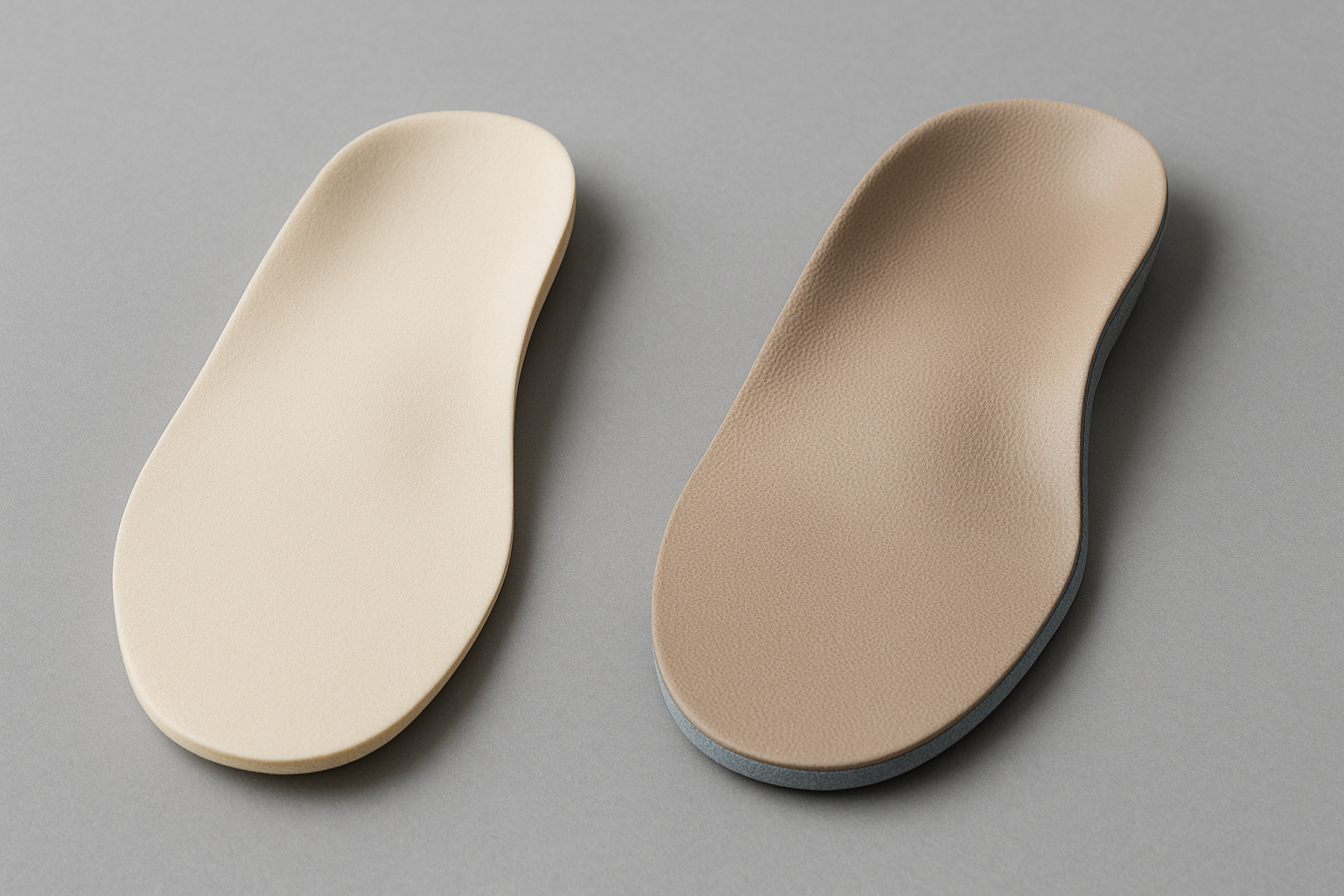
A precisely molded custom orthotic (right) delivers targeted pressure redistribution impossible to replicate with a generic prefabricated insert (left).
The Science Behind Pressure Relief and Diabetic Ulcer Prevention
The clinical case for orthotics in diabetic foot care is well established. Research published in Diabetes Care demonstrated that custom therapeutic footwear and orthotics significantly reduced the recurrence of plantar ulcers in high-risk diabetic patients compared to standard footwear. Studies using pedobarographic (pressure-mapping) analysis consistently show that custom insoles reduce peak plantar pressure by 30–50% at the metatarsal heads — the most commonly ulcerated sites in diabetic feet.
How Orthotics Reduce Plantar Pressure
The mechanism is biomechanical. Every step places force — measured in pounds per square inch — on the plantar surface of the foot. In a healthy foot, this load is distributed across a broad contact area. In a diabetic foot with structural changes (fat pad atrophy, prominent metatarsal heads, collapsed arches), pressure concentrates at isolated spots. Over thousands of steps per day, that concentrated force breaks down tissue, causing callus, then skin breakdown, and ultimately ulceration.
A custom orthotic engineered with total contact design spreads that load across the entire plantar surface — redistributing force away from vulnerable bony prominences and toward areas of greater tolerance. The result is a meaningful reduction in peak pressure at every high-risk site.
The Role of Shear Force Reduction
Pressure alone does not fully explain ulcer formation. Shear stress — the horizontal friction generated as the foot slides within the shoe during each step — plays an equally important and often underappreciated role. Even small amounts of repeated shear can degrade the structural integrity of neuropathic skin far faster than vertical pressure alone.
Quality diabetic orthotics address shear through the selection of appropriate top-cover materials — low-friction, moisture-managing surfaces that reduce the sliding force at the skin interface. This dual approach — managing both vertical pressure and horizontal shear — is what separates a clinically effective diabetic orthotic from a simple cushioned insole.
Risk Stratification: Who Needs Orthotics Most Urgently
Not every diabetic patient carries the same level of foot complication risk. Clinical guidelines identify several factors that elevate risk and make custom orthotics especially urgent:
- Peripheral neuropathy confirmed by monofilament testing — loss of protective sensation at any plantar site
- History of prior foot ulcer — the single strongest predictor of future ulceration
- Peripheral arterial disease — reduced blood flow compounding healing impairment
- Foot deformity — Charcot foot, hammertoes, bunions, prominent metatarsal heads
- Plantar callus formation — a warning sign of concentrated pressure
- End-stage renal disease — further compromises healing capacity
- Poor glycemic control (HbA1c > 8%) — ongoing elevated glucose accelerates nerve and vessel damage
If you or a family member falls into any of these categories, scheduling a podiatric assessment and fitting for custom orthotics should be treated as urgent preventive care — not an elective choice.
Custom vs. Over-the-Counter: Why the Distinction Is Life-Changing for Diabetics
The gap between custom orthotics and over-the-counter insoles is far greater for diabetic patients than for any other population. For a healthy foot, an off-the-shelf insole might provide acceptable comfort. For a diabetic foot, the stakes of a poor fit are measured in skin integrity, wound risk, and ultimately in limb preservation.
Custom orthotics are fabricated from individual molds or three-dimensional scans of each patient's feet. Every contour, arch height, pressure zone, and bony prominence is captured and incorporated into the design. The orthotic is then built to meet the exact anatomy of that specific foot — not an average foot. The result is a device that provides consistent, predictable, and precise pressure management across the entire plantar surface.
At customorthotics.com, orthotics are crafted directly from individual foot molds by a podiatrist-owned practice with more than 20 years of clinical experience. That level of precision and podiatric oversight cannot be replicated by a mass-produced product. For a deep dive into the specific benefits of custom insoles for people with diabetes, see their dedicated resource on custom insoles for diabetes.
Materials That Matter: What Goes Into a Diabetic Orthotic
Material selection is not a secondary consideration in diabetic orthotic design — it is central to clinical effectiveness. The wrong material can transfer harmful stress to vulnerable skin rather than absorbing it. Here is a breakdown of the materials most commonly used and why they are chosen:
Plastazote (Closed-Cell Polyethylene Foam)
Plastazote is widely regarded as the gold standard top-cover material for diabetic orthotics. It is heat-mouldable, meaning it conforms further to the exact plantar surface when warmed — a process called self-moulding. It has excellent shock absorption, minimal shear generation, and is hypoallergenic. Available in varying densities, it can be layered to achieve the desired balance of cushioning and support.
EVA (Ethylene-Vinyl Acetate) Foam
EVA foam is one of the most versatile orthotic materials, available in densities ranging from very soft to semi-rigid. Soft EVA is frequently used as a base layer in diabetic orthotics for its excellent energy-absorbing properties. Medium-density EVA provides structural integrity without creating hard edges. It is lightweight, durable, and easily modified by a podiatrist to create metatarsal pads, heel cups, or offloading apertures.
Poron (Urethane Foam)
Poron is a medical-grade polyurethane foam that excels at absorbing high-impact shock at heel strike and toe-off. Unlike standard foam, Poron returns to its original shape after compression — maintaining consistent cushioning over thousands of steps without "bottoming out." It is frequently used beneath high-pressure areas in diabetic insoles.
Multi-Layer Composite Construction
The most clinically effective diabetic orthotics combine multiple layers — each selected for a specific functional role. A typical multi-layer diabetic orthotic might include a firm EVA base for structural support, a Poron mid-layer for shock absorption, and a Plastazote top cover for skin-safe cushioning and shear reduction. This is the architecture behind the quad-layer orthotics available through customorthotics.com — engineered to deliver both protection and stability in one device.
Why Rigid Materials Must Be Avoided
Rigid orthotics made from polypropylene or carbon fiber — which are appropriate for biomechanical correction in healthy feet — are contraindicated in most diabetic patients. Hard materials create unyielding contact surfaces that generate focal pressure points. In a foot without protective sensation, those pressure points silently damage tissue with every step. Any orthotic prescribed for a diabetic foot must prioritize compliance and cushioning over rigidity.
How to Get Custom Orthotics for Diabetic Foot Care
The process of obtaining custom orthotics for diabetic foot care is straightforward when you work with an experienced podiatric provider. Below is a detailed step-by-step overview.
-
Schedule a consultation with a qualified podiatrist.
Contact a podiatrist — or visit customorthotics.com to book a complimentary phone consultation — and discuss your diabetes history, current foot concerns, neuropathy status, and any prior ulcers or complications. This initial conversation allows the provider to understand your risk level and determine what type of orthotic design is appropriate before the foot assessment begins.
-
Undergo a comprehensive diabetic foot assessment.
The podiatrist conducts a thorough clinical examination: monofilament sensation testing, vascular assessment, gait analysis, and identification of pressure points and structural deformities. This is not simply "measuring your foot" — it is a clinical evaluation that drives every design decision in the orthotic that follows.
-
Have precise foot molds or 3D scans taken of both feet.
The podiatrist takes plaster casts, foam impression molds, or three-dimensional digital scans of each foot in the appropriate weight-bearing or non-weight-bearing position. This step captures the exact geometry of your foot and becomes the physical template from which the orthotic is fabricated. Accuracy here is non-negotiable for clinical effectiveness.
-
Select the right orthotic design, materials, and modifications.
Working with your podiatrist, choose the appropriate cushioning layers, top-cover material, structural base, and any special modifications — such as metatarsal pads, heel cups, offloading apertures for existing ulcers, or toe filler accommodation for post-amputation feet. These decisions are driven by your clinical assessment, not by what is available off the shelf.
-
Receive your orthotics and follow a structured break-in protocol.
Once fabricated and delivered, begin wearing the orthotics for 1–2 hours on the first day and increase wear time by 1–2 hours daily over two to four weeks. Inspect your feet before and after each wearing session for any areas of redness, pressure, or irritation — especially critical because neuropathy may prevent you from feeling discomfort. Report any skin changes to your podiatrist immediately.
-
Maintain a regular follow-up schedule with your podiatric provider.
Return at least annually — or more frequently if your foot health changes — for orthotic inspection, wear assessment, and foot re-evaluation. Orthotics compress and degrade over time, and a worn orthotic may no longer provide adequate pressure relief. Medicare covers reassessment and replacement orthotics as part of the Therapeutic Shoes benefit on an annual basis.

Proper orthotic support helps diabetic patients remain active — and sustained daily activity is itself a key component of blood sugar management and long-term health.
Everyday Comfort, Mobility, and the Activity-Glucose Cycle
The clinical importance of diabetic orthotics extends far beyond ulcer prevention. Many people with diabetes gradually reduce their activity levels because of foot pain, fear of injury, or discomfort when walking. This reduction in physical activity directly worsens blood sugar control — creating a vicious cycle where diabetes damages the feet, foot pain reduces activity, and reduced activity accelerates the metabolic deterioration driving further foot damage.
Properly fitted custom orthotics for diabetic foot care interrupt this cycle. When walking becomes less painful and more sustainable, patients naturally move more. And regular physical activity is one of the most potent tools available for improving insulin sensitivity and glucose control. The orthotic, in this sense, functions as both a wound prevention device and a metabolic health intervention.
Many patients report that after receiving their first pair of well-fitted custom diabetic orthotics, they are able to return to walks, shopping trips, and daily activities they had quietly given up because of foot discomfort. That restoration of mobility has quality-of-life benefits that go well beyond the clinical metrics. For a broader overview of what to expect from custom orthotic support in daily life, see the complete guide to the best orthotics for everyday use.
What to Look for When Choosing a Diabetic Orthotic Provider
Not all orthotic providers are equivalent. For diabetic foot care specifically, the qualifications and clinical approach of the provider matter enormously — because an improperly designed orthotic can cause more harm than no orthotic at all. Here is what to evaluate:
- Podiatric credentials and diabetic foot expertise — look for a Doctor of Podiatric Medicine (DPM) with specific experience treating diabetic patients, not a general orthotic retailer
- Individual foot molding, not size-based fitting — genuine custom orthotics require a physical mold or 3D scan of your feet, not a shoe size or arch type selection
- Material transparency — the provider should be able to explain what materials are used in your orthotic and why those specific choices were made for your foot condition
- Follow-up and adjustment policy — a reputable provider includes follow-up visits to assess fit and make modifications; orthotics often require minor adjustments after the break-in period
- Insurance navigation support — an established practice helps patients access Medicare or private insurance coverage and provides the necessary prescription documentation
- Accessibility options — for patients who cannot easily travel, look for providers offering remote consultation and secure online ordering with podiatric oversight
customorthotics.com meets every criterion above — a podiatrist-owned and operated practice with over two decades of experience crafting custom orthotics from individual foot molds, offering both in-person assessment and a streamlined online ordering pathway for patients anywhere in the country.
Insurance Coverage for Diabetic Orthotics and Therapeutic Footwear
Cost is a genuine concern for many patients, but it should not be a barrier to accessing necessary foot care. Multiple insurance pathways exist for diabetic orthotics, and most patients with a qualifying diagnosis and a podiatrist's prescription can access significant coverage.
Medicare Part B: Therapeutic Shoes for People with Diabetes
Medicare's Therapeutic Shoes for People with Diabetes benefit covers, per calendar year:
- One pair of custom-molded shoes plus three pairs of custom molded inserts, OR
- One pair of extra-depth shoes plus three pairs of custom inserts
To qualify, the patient must have diabetes, be enrolled in Medicare Part B, have a certifying physician document that the patient has diabetes and is being managed for it, and have the prescription fulfilled by a qualified podiatrist, orthotist, or pedorthist. After the Part B deductible, Medicare typically pays 80% of the approved amount.
Private Insurance and Medicaid Coverage
Many private insurers cover custom diabetic orthotics when they are medically necessary and prescribed by a physician or podiatrist. Coverage terms — including deductibles, co-pays, annual limits, and documentation requirements — vary by plan. Medicaid coverage also varies significantly by state. A podiatrist experienced in insurance billing can help navigate the prior authorization process and ensure claims are properly documented.
What to Do Before Ordering
- Call your insurer to confirm orthotic and diabetic footwear benefits
- Ask your podiatrist for a formal prescription documenting medical necessity
- Confirm the provider is enrolled as a Medicare or insurance-contracted supplier if you intend to bill insurance
- Keep records of all prior authorizations, receipts, and clinical notes for claims processing
customorthotics.com makes access straightforward — whether you are local, ordering remotely, or navigating insurance for the first time. Patients can connect directly with the podiatrist for a complimentary consultation by phone or place orders through the online platform, removing the logistical barriers that too often delay necessary foot care.
Frequently Asked Questions About Orthotics for Diabetic Foot Care
What are orthotics for diabetic foot care and how do they work?
Orthotics for diabetic foot care are custom-fabricated shoe inserts designed to redistribute plantar pressure, cushion sensitive areas, reduce shear friction, and protect feet compromised by neuropathy and poor circulation. They work by spreading load across the entire sole rather than allowing it to concentrate at bony prominences, which prevents the tissue breakdown that leads to ulcers.
Why do people with diabetes need special orthotics rather than regular insoles?
Diabetes causes peripheral neuropathy (loss of protective foot sensation) and impaired circulation, meaning a pressure point that a healthy person would feel and adjust to can silently destroy diabetic tissue over thousands of steps. Regular insoles use generic sizing that cannot account for individual foot deformities, creating new pressure points that go undetected and cause harm. Custom diabetic orthotics are built from individual foot molds to eliminate those risks precisely.
What is the difference between diabetic shoes and diabetic orthotics?
Diabetic shoes protect the foot from external friction with wider toe boxes, extra depth, and seamless interiors. Diabetic orthotics manage plantar pressure from the inside by redistributing load and cushioning high-risk areas. The two serve complementary roles, and the most protective approach combines both — a therapeutic shoe with a custom orthotic insert fitted inside it.
Can orthotics for diabetic foot care prevent amputations?
Yes — indirectly but powerfully. Diabetic foot amputations are almost always preceded by a foot ulcer that becomes infected. Custom orthotics significantly reduce plantar pressure and shear stress, the two primary mechanical drivers of ulcer formation. By preventing ulcers, they break the chain of events that leads to amputation. Research demonstrates that therapeutic footwear with custom inserts substantially reduces ulcer recurrence in high-risk diabetic patients.
What foot conditions in diabetic patients can orthotics treat?
Custom diabetic orthotics can help manage plantar ulcer prevention and offloading, neuropathic pain and discomfort, Charcot foot accommodation and support, hammertoe and digital deformity pressure relief, plantar fasciitis, metatarsalgia, heel pain, flat arches, bunion accommodation, and post-amputation foot rebalancing.
How long do custom diabetic orthotics last?
Most custom diabetic orthotics last one to three years depending on activity level, body weight, and materials used. Soft foam layers compress over time and eventually lose their pressure-relieving properties. It is critical to have orthotics inspected regularly, as a worn orthotic may actually create new pressure points. Medicare's Therapeutic Shoes benefit allows for annual replacement of inserts.
Are diabetic orthotics covered by Medicare and insurance?
Yes. Medicare Part B covers one pair of custom-molded or extra-depth shoes plus three pairs of custom inserts per calendar year for qualifying diabetic patients. Most private insurers also cover custom diabetic orthotics when prescribed by a podiatrist and documented as medically necessary. Always verify your specific plan's benefits and obtain a formal prescription before ordering.
What materials are used in the best diabetic orthotics?
The most effective diabetic orthotics use multi-layer constructions combining Plastazote (a heat-mouldable closed-cell foam that minimizes shear), EVA foam (for structural base and energy absorption), and Poron urethane foam (for impact resilience under high-pressure zones). Rigid materials like polypropylene are contraindicated in diabetic patients because they can create focal pressure points that damage neuropathic skin silently.
How do I get fitted for diabetic orthotics?
A podiatrist conducts a clinical diabetic foot assessment — including monofilament sensation testing, vascular evaluation, and gait analysis — then takes precise plaster casts, foam molds, or 3D digital scans of both feet. At customorthotics.com, you can begin with a complimentary phone consultation or proceed directly through the secure online ordering process with podiatric oversight at every step.
Can I wear diabetic orthotics in any shoe?
Custom diabetic orthotics fit best in shoes with removable insoles and adequate depth to accommodate the orthotic without compressing the foot or toes. Extra-depth diabetic shoes are the ideal pairing. Standard dress shoes or narrow footwear with non-removable insoles are typically incompatible with custom orthotics and should be avoided by diabetic patients regardless.
What is the difference between diabetic orthotics and standard orthotics?
Standard orthotics primarily target biomechanical issues like arch support, gait correction, and overpronation. Diabetic orthotics prioritize pressure offloading, skin protection, shear reduction, and deformity accommodation — often at the expense of rigidity. The design philosophy is fundamentally different: standard orthotics correct movement mechanics, while diabetic orthotics protect vulnerable tissue from the consequences of every movement.
How soon will I feel relief after starting diabetic orthotics?
Many patients notice improved comfort within the first few days of wearing custom diabetic orthotics. Full adaptation typically takes two to four weeks as the foot adjusts to the new pressure distribution. During this period, inspect your feet before and after each session — and contact your podiatrist if you notice any redness, skin changes, or pressure marks, as neuropathy may prevent you from feeling discomfort that is still causing damage.
Daily Foot Inspection: The Habit That Works Alongside Orthotics
Even the best orthotics for diabetic foot care are one component of a broader protective strategy. The most important complementary habit is daily self-inspection of both feet — a practice recommended by every major diabetes clinical guideline and one that dramatically reduces the risk of undetected injury escalating into a serious wound.
Each day, before and after wearing your orthotics and footwear, inspect every surface of both feet — including between the toes and across the heel — for:
- Redness, warmth, or swelling (early signs of pressure injury or infection)
- Blisters, cuts, or skin breaks of any size
- Callus formation or thickening over bony prominences
- Changes in skin color or temperature between feet
- Any areas where the orthotic or shoe may be creating contact marks
Use a mirror or ask a family member to help inspect areas that are difficult to see. Any finding — no matter how minor it appears — should be reported to your podiatrist without delay. In diabetic foot care, "watch and wait" is never the appropriate response to a new skin finding.
Conclusion: Orthotics for Diabetic Foot Care Are Non-Negotiable Preventive Medicine
Orthotics for diabetic foot care represent one of the most evidence-backed, clinically established, and cost-effective investments a person with diabetes can make in their long-term health. They reduce ulcer incidence, lower amputation risk, restore daily comfort, support physical activity, and directly address the structural complications that diabetes causes in the feet over time. They are most effective when custom-made — built precisely from individual foot molds by a podiatrist who understands the specific vulnerabilities of the diabetic foot — and when used in combination with appropriate therapeutic footwear, daily inspection, and regular clinical follow-up.
If you or someone you care for is living with diabetes, do not wait for a foot problem to become serious before acting. customorthotics.com offers a clear, accessible path to clinical-grade diabetic orthotics — with a complimentary consultation, podiatrist oversight at every step, online ordering capability, and more than 20 years of podiatric expertise behind every device fabricated. Your feet carry you through every day of your life. They deserve protection designed specifically for them.