

Custom Foot Supports for Standing Jobs: The Complete Guide
Updated July 2025 | 14-minute read | Occupational Foot Health
Custom foot supports for standing jobs are individually crafted orthotic insoles designed to eliminate pain, reduce fatigue, and prevent long-term injury in workers who stand for hours every shift. If you work on hard floors for six, eight, or twelve hours a day, the right foot support is not a luxury — it is a clinical necessity that directly affects your health, performance, and career longevity.
According to the U.S. Bureau of Labor Statistics, musculoskeletal disorders account for nearly 30% of all worker injury and illness cases requiring days away from work — and a disproportionate share of those injuries trace back to the feet. Yet the majority of standing workers have never been properly assessed for foot mechanics.
This guide covers everything: what custom foot supports are, why standing jobs demand them specifically, how the fitting process works step by step, how to choose the right material, what they cost, and how to make them last. By the end, you will have a complete picture of whether custom orthotics are right for your job — and exactly how to get them.
What Are Custom Foot Supports for Standing Jobs?
Custom foot supports are prescription orthotic devices fabricated specifically for the shape, weight distribution, and biomechanics of your individual feet. Unlike pharmacy insoles that are manufactured in generic sizes and assume every foot is alike, custom orthotics are made from a precise 3D digital scan or plaster cast taken by a licensed podiatrist or certified orthotist.
That scan captures your unique arch height, heel angle, forefoot width, and dynamic pressure pattern as you walk. The resulting device corrects the specific mechanical problems your feet actually have — not the generic ones a mass-market product guesses you might have.
Common issues addressed by custom work orthotics include:
- Overpronation — the foot rolls inward excessively, stressing the arch, ankle, and knee
- Supination (underpronation) — the foot rolls outward, concentrating pressure on the outer edge
- Flat arches (pes planus) — the arch collapses under load, spreading the foot and destabilizing posture
- High arches (pes cavus) — reduced surface contact creates concentrated pressure points at the heel and ball
- Leg length discrepancy — even minor differences cause compensatory gait patterns that lead to hip and back pain
- Uneven load distribution — hot spots under specific metatarsal heads that cause calluses and nerve compression
Custom supports are fabricated in different materials — rigid polypropylene, semi-rigid carbon fiber composites, or soft accommodative foam — matched to the specific demands of your occupation and your foot condition. The combination of precision fitting and material selection is what separates them decisively from anything available off the shelf.
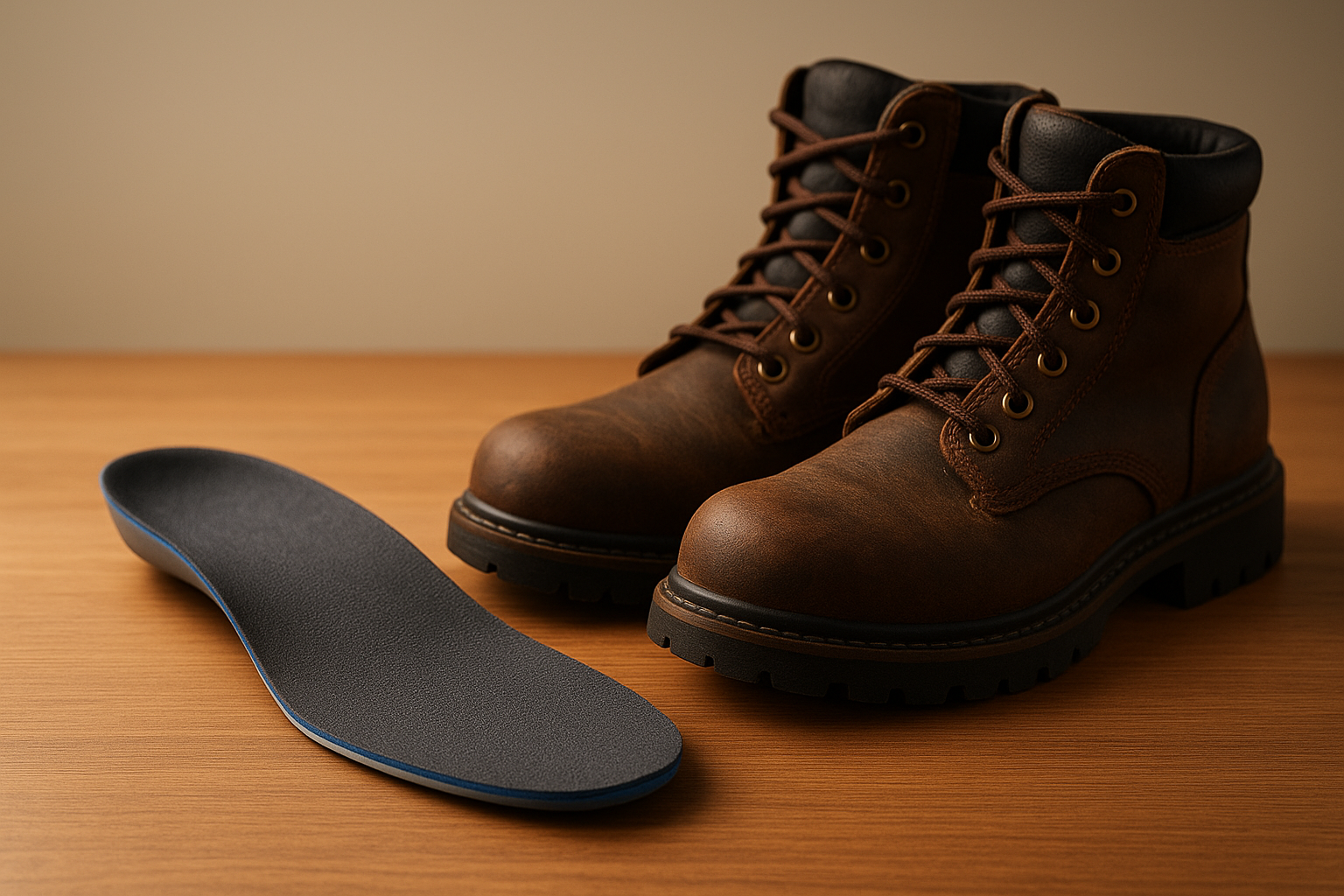
Custom foot supports are precision-crafted to fit directly inside the work footwear you wear every day on the job. For a deeper walkthrough, see our Custom Foot Supports for Work: Relief for Standing Jobs.
Why Standing Jobs Create Unique Foot Health Challenges
The human body was not engineered for eight hours of static standing on concrete or tile. Walking actually reduces plantar pressure peaks through the rolling motion of the gait cycle — standing locks those pressures in place continuously.
When you stand still on a hard floor, the heel absorbs roughly 60% of your body weight with every minute that passes. Over a ten-hour shift, the cumulative compressive load on the plantar fascia, heel pad, and metatarsal heads is enormous. The body's natural shock-absorption systems — the fat pad of the heel, the plantar fascia, and the arch spring mechanism — were designed for intermittent impact, not constant compression.
The Most Common Foot Conditions in Standing Workers
Occupational health research identifies a cluster of conditions that appear disproportionately in workers who stand for extended periods:
- Plantar fasciitis — inflammation of the thick connective tissue band running from the heel to the ball of the foot; the most common occupational foot complaint, producing sharp morning pain and a burning ache after long shifts
- Heel spurs — calcium deposits that form at the heel bone in response to chronic fascia tension, often developing silently alongside plantar fasciitis
- Metatarsalgia — sharp pain and inflammation in the ball of the foot, caused by excessive pressure on the metatarsal heads during prolonged standing
- Morton's neuroma — thickening of the tissue around a nerve between the toes, producing a burning or electric-shock sensation, most common in workers wearing narrow footwear on hard floors
- Tibialis posterior tendinopathy — gradual degradation of the tendon that supports the inner arch, leading to progressive flat-foot deformity if left untreated
- Chronic edema — fluid accumulation in the lower legs and feet due to prolonged venous pooling in a standing position
Which Occupations Are Most at Risk?
Certain professions carry consistently elevated rates of occupational foot pain and lower limb musculoskeletal disorders. The workers who benefit most from custom foot supports for standing jobs include:
- Nurses and healthcare workers — frequently cited in studies as experiencing the highest rates of foot and lower back pain among all professional groups
- Retail and supermarket staff — standing and walking on tile and concrete for full shifts with limited rest opportunities
- Chefs and kitchen workers — hard kitchen floors, compulsory footwear standards, and restricted movement patterns
- Manufacturing and assembly line workers — static standing at fixed workstations on concrete or steel plate
- Construction and trades workers — uneven surfaces, heavy safety footwear, and significant walking distances
- Teachers — standing on hard classroom floors throughout the day, often underestimated as a high-risk group
- Hairdressers and salon professionals — prolonged static standing on hard surfaces, often in non-supportive footwear
- Security and law enforcement personnel — long shifts combining extended standing with occasional rapid movement
How Foot Problems Cascade Up the Kinetic Chain
The feet are the foundation of the kinetic chain — the interconnected system of joints, muscles, and soft tissues linking your feet to your spine. What happens at the feet does not stay at the feet. Overpronation causes inward rotation of the tibia, which in turn alters knee tracking and stresses the medial compartment. That tibial rotation shifts hip mechanics, increasing compressive loading on one side of the pelvis. The resulting pelvic tilt transmits asymmetric force up through the lumbar spine.
This explains why many standing workers who present with chronic lower back pain, recurring knee inflammation, or hip bursitis receive significant relief after being fitted for custom foot supports — even when the original complaint had nothing to do with their feet. Addressing the foundation corrects the entire structure above it.
Custom vs. Over-the-Counter Insoles: A Definitive Comparison
The market is flooded with insoles claiming to solve standing-related foot pain. Understanding the genuine differences between custom orthotics and retail insoles prevents costly mistakes.
A 2018 study in the Journal of Foot and Ankle Research found that workers using custom orthotics reported a 34% reduction in foot pain scores after eight weeks, compared to a control group using standard cushioned insoles. No retail insole product has produced comparable results in controlled occupational settings.
Key Benefits of Custom Orthotics for Workers Who Stand All Day
The measurable benefits of properly fitted custom foot supports extend far beyond basic comfort: For a deeper walkthrough, see our Custom Foot Molds: Complete Guide to Getting Fitted.
- Precision pressure redistribution: Spreads plantar load evenly across the entire foot surface, eliminating the hot spots that cause calluses, corns, and metatarsal pain.
- Corrected gait alignment: Guides the foot into its biomechanically optimal position, reducing cumulative strain on the ankle, knee, hip, and spine with every step and every standing hour.
- Dramatically reduced end-of-shift fatigue: Workers fitted with custom orthotics consistently report significantly less leg and foot tiredness at the end of their shift — a benefit that compounds across a career.
- Prevention of plantar fasciitis and heel spurs: By offloading the plantar fascia and reducing tensile stress on the heel attachment point, custom supports interrupt the inflammatory cycle before it becomes entrenched.
- Protection against stress fractures: Redistributing impact forces reduces peak loading on vulnerable metatarsal bones — a particular benefit for workers on concrete who are at risk of fatigue fractures.
- Improved standing posture: Correct foot alignment cascades upward, reducing lumbar lordosis strain and improving overall spinal posture during static standing tasks.
- Lower absenteeism and career longevity: Research consistently shows that workers using appropriate foot support take fewer sick days related to musculoskeletal pain and are able to sustain physically demanding careers longer.
- Management of diabetes-related foot risk: Soft accommodative orthotics are a clinical standard for diabetic workers, reducing ulceration risk by eliminating pressure peaks on insensate tissue.
How to Get Custom Foot Supports: Step-by-Step Guide
Getting properly fitted custom orthotics for your standing job is a clearly defined clinical process. Here is exactly how it works from start to finish:
-
1
Schedule a Podiatric or Orthotic Assessment
Book an appointment with a licensed podiatrist or certified orthotist (CO). Bring the actual work footwear you wear most often — your provider needs to assess compatibility between your foot geometry and the shoe's internal volume. If you wear steel-toed boots or specialist occupational footwear, inform the clinic when you book so they can prepare appropriately.
-
2
Undergo a Comprehensive Gait Analysis and Foot Scan
The specialist will observe your walking and standing pattern on a pressure plate or treadmill system. A 3D digital scan or plaster impression is then taken of each foot in a neutral, subtalar-joint-neutral position. This creates the exact geometric template used to fabricate your devices. Some clinics use dynamic pressure mapping that records real-time force distribution as you walk — providing even richer data for orthotic design.
-
3
Select the Right Material and Design for Your Work Environment
Discuss your specific flooring surfaces, the physical demands of your role, and your footwear requirements with your orthotist. Your provider will recommend rigid, semi-rigid, or accommodative construction based on this information. They will also determine whether any additions are needed — metatarsal pads, heel cups, top-cover materials, or extensions for specific anatomical corrections.
-
4
Fabrication and Delivery (Typically 1–3 Weeks)
Your scan or mold is sent to an orthotic laboratory where technicians use computer-aided manufacturing (CAM) milling or vacuum-forming techniques to fabricate the device. Standard turnaround is one to three weeks. Some clinics with in-house lab capability can deliver in as little as 48–72 hours if your situation requires urgent resolution.
-
5
Begin a Structured Break-In Protocol
Begin wearing your new orthotics for two to three hours on the first day. Increase by one to two hours per day over the following week. By days 10–14, most workers can wear them for a complete shift comfortably. Some soreness in the arch or calf during the first few days is normal — it reflects muscles that are adapting to a corrected alignment they have never used before. Persistent sharp pain is not normal and should prompt an immediate call to your provider.
-
6
Attend Follow-Up Adjustments
Return to your provider two to four weeks after starting full-time wear. Minor trim modifications, post adjustments, or top-cover replacements are common at this stage and are typically included in the initial fee. A well-executed follow-up is what separates a comfortable long-term outcome from persistent complaints. Plan for at least one follow-up visit in the first six weeks.
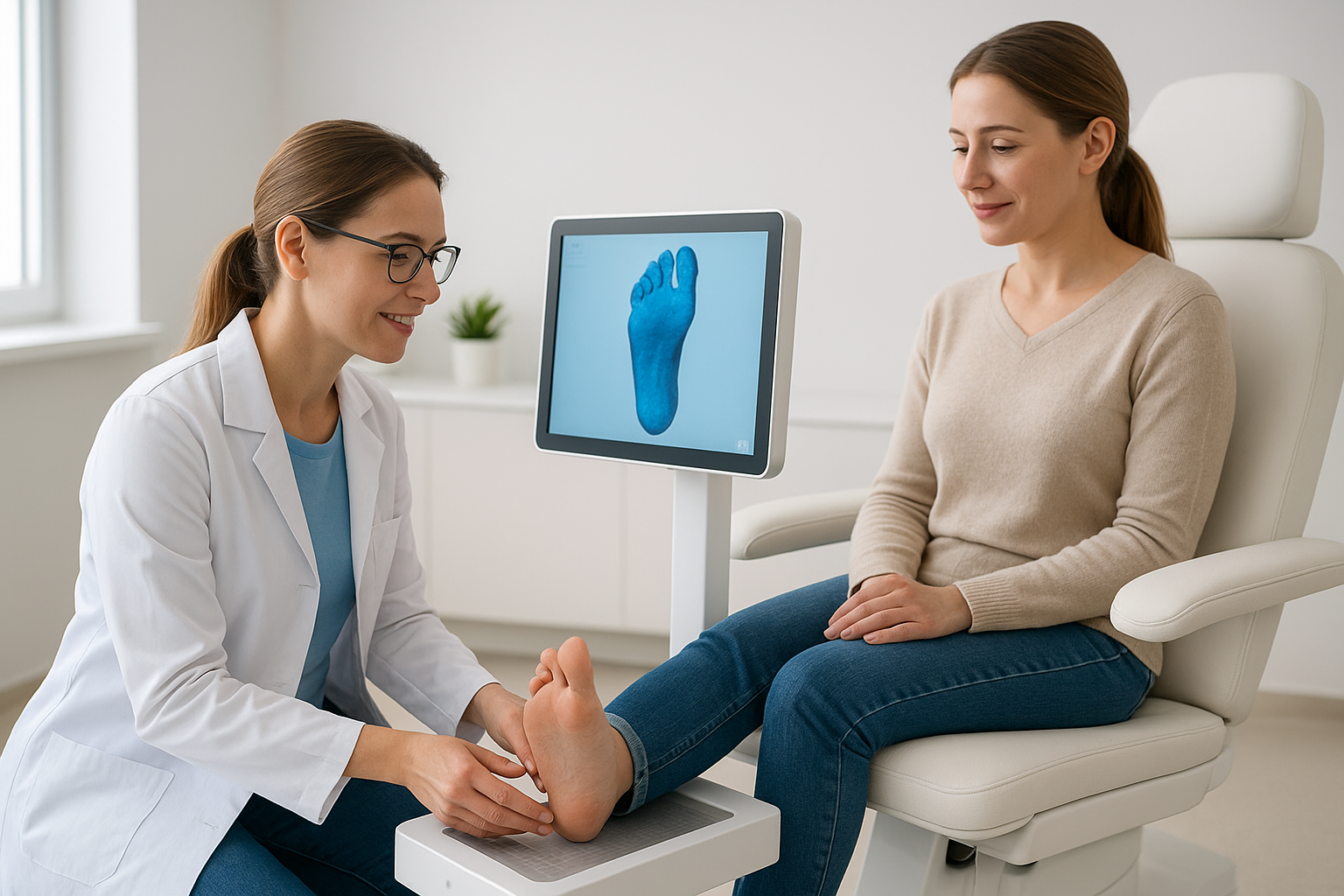
A 3D foot scan captures the precise measurements needed to manufacture truly personalized orthotic devices.
Choosing the Right Orthotic Material for Your Job
Material selection is one of the most important decisions in the orthotic design process. The wrong material for your work environment will undermine even a perfectly fitted device. Here is a practical breakdown of each major category:
Rigid Orthotics (Functional)
Materials: Polypropylene, carbon fiber composite
Best for: Workers who stand predominantly in a fixed position on hard, flat surfaces — surgical staff, assembly line operators, quality control inspectors
Function: Controls abnormal foot motion (particularly pronation) very effectively; provides firm structural correction under the arch and heel
Limitation: Less cushioning; can feel hard until fully broken in; not ideal for workers who walk significant distances during their shift
Semi-Rigid Orthotics
Materials: Carbon fiber or thin polypropylene shell with EVA or leather top cover and cushioning layers
Best for: Workers who both stand and walk throughout their shift — nurses, retail workers, warehouse staff, teachers, tradespeople
Function: Balances motion control with shock absorption; the most versatile category and the most commonly prescribed for occupational use
Limitation: Slightly bulkier than rigid-only designs; requires adequate shoe depth
Soft / Accommodative Orthotics
Materials: Plastazote foam, Poron, silicone gel, layered EVA
Best for: Workers with diabetes, peripheral neuropathy, rheumatoid arthritis, or severely compromised tissue integrity; also appropriate for elderly workers
Function: Maximizes pressure distribution and cushioning; protects vulnerable tissue from ulceration and breakdown
Limitation: Provides limited biomechanical correction; compresses over time and requires more frequent replacement (often every 12–18 months)
Fitting Orthotics into Safety and Work Footwear
A common concern is whether custom supports can be accommodated inside heavy-duty work footwear. The answer, in the large majority of cases, is yes — with appropriate preparation. Your orthotist will trim or shape the device to the exact footprint of your shoe. You will almost always need to remove the factory-fitted insole to create adequate depth. If your work requires steel-capped boots, composite-toe footwear, or metatarsal guard boots, communicate this at your initial consultation. The orthotic profile will be designed accordingly, accounting for the reduced internal volume and specific toe-box geometry.
If you are buying new work footwear to pair with custom orthotics, look for shoes with a removable insole, a roomy toe box, and adequate heel cup depth — typically at least 10–12mm below the top of the heel counter. A depth of 5–6mm across the forefoot is recommended for semi-rigid devices.
Condition-Specific Guidance: Orthotics for Common Standing Worker Complaints
The right orthotic design varies meaningfully depending on which condition is driving your symptoms. Understanding what your specific situation requires helps you have a more productive conversation with your provider.
Plantar Fasciitis
Orthotics for plantar fasciitis need a deep heel cup (at least 35–40mm) to centralize the heel fat pad directly under the calcaneus, plus adequate medial arch support to reduce tensile load on the fascial insertion. A slight heel raise of 4–6mm can also reduce morning pain by slightly slackening the fascia overnight. Evidence consistently supports custom orthotics as a first-line treatment for occupational plantar fasciitis.
Metatarsalgia and Morton's Neuroma
Forefoot pain conditions require a metatarsal pad or bar positioned proximal to the metatarsal heads — typically 10–15mm behind the MTP joints — to redistribute compressive load away from the inflamed area. For Morton's neuroma specifically, a metatarsal pad placed between the third and fourth metatarsal heads creates a spreading effect that reduces neurovascular compression.
Flat Feet (Pes Planus) and Overpronation
Flat-foot orthotics require a firm medial longitudinal arch support with a medial heel skive — a wedging modification that tilts the calcaneus into slight varus (inversion) to counteract the excessive pronation force. A rearfoot post may also be included for workers whose pronation is driven primarily from the rear of the foot rather than from midfoot collapse.
High Arches (Pes Cavus)
High-arch feet have reduced ground contact area, concentrating load at the heel and metatarsal heads. Custom orthotics for this pattern use a lateral heel flare and extensive forefoot cushioning to increase total contact area. A full-contact soft top cover is usually added to cushion the vulnerable tissue between bony prominences.
Diabetic Workers
For workers with diabetes and reduced peripheral sensation, the pressure-redistribution function of orthotics is medically critical, not merely beneficial. Soft accommodative devices using multi-density Plastazote are the clinical standard. Pressure mapping is especially important in this population to verify that no single site exceeds the threshold for ischemic damage. In many countries, custom orthotics for diabetic workers are reimbursed as a medical necessity.
Cost, Insurance Coverage, and Return on Investment
Custom orthotics typically cost between $300 and $800 USD for a professionally fabricated pair. That range reflects differences in material complexity, clinic overhead, and the geographic market. While the upfront cost is higher than retail insoles, the total cost of ownership over two to five years of use is typically lower — and the therapeutic outcome is in a different category entirely.
Insurance and Coverage Options
- Private health insurance: Many employer-provided plans in the U.S. cover custom orthotics when prescribed by a licensed podiatrist or physician. Coverage levels vary from partial (50–80%) to full. Check your plan's DME (Durable Medical Equipment) benefit section.
- HSA and FSA accounts: Custom orthotics with a prescription qualify as an eligible medical expense under Health Savings Accounts (HSA) and Flexible Spending Accounts (FSA), allowing you to pay with pre-tax dollars and effectively reducing the cost by your marginal tax rate.
- Workers' compensation: If your foot condition is work-related — developed or significantly worsened by the demands of your job — workers' compensation insurance may cover the full cost. Your employer's HR or safety department can provide guidance on filing a claim.
- Medicare and Medicaid: Coverage is available for specific populations and conditions. Diabetic workers may qualify for therapeutic footwear and orthotics under Medicare's Therapeutic Shoe Bill (Section 4072 of OBRA '87).
How Long Do Custom Foot Supports Last?
High-quality custom orthotics last two to five years with proper care. Workers in high-mileage roles — nurses, retail staff, construction workers — who cover 8,000–15,000 steps per shift will typically be at the lower end of that range. Workers in more static roles often get five or more years from a single pair. Signs that replacement is needed include visible compression of cushioning layers, cracking of the shell, or a return of the symptoms that were resolved when the orthotics were new.
Care and Maintenance to Maximize Lifespan
- Wipe down with a damp cloth after each shift — do not submerge in water
- Air-dry at room temperature; never use a dryer, heater, or direct sunlight
- Rotate between two pairs if you use orthotics in multiple shoes — this extends the life of both pairs
- Replace worn top covers (the fabric or leather surface layer) every 12–18 months to maintain hygiene and cushioning
- Store flat when not in use — never bend, fold, or stack rigid devices

Healthcare workers who stand for extended shifts are among the most significant beneficiaries of custom arch support and pressure redistribution.
Complementary Strategies to Maximize Comfort on the Job
Custom orthotics are the most powerful single intervention for standing worker foot health, but they deliver maximum results when combined with a few complementary strategies:
Choosing the Right Work Footwear
Orthotics perform best inside footwear designed to accommodate them. Look for shoes with a removable insole, at least a 10–12mm heel-to-toe drop, a stable heel counter, and sufficient toe box width. Avoid flat-soled canvas shoes or minimalist designs when using rigid orthotics — the lack of a heel raise places extra tensile stress on the plantar fascia regardless of orthotic support. For nursing, slip-resistant clogs with a deep heel cup and wide forefoot are generally well-regarded. For construction and trades, safety boots with a removable liner and a reinforced midfoot shank work well with semi-rigid orthotic designs.
Anti-Fatigue Matting
In environments where you have control over your workspace — kitchen stations, assembly benches, checkout counters — anti-fatigue matting reduces ground reaction force by approximately 50% compared to bare concrete. Used alongside custom orthotics, matting creates a compounding benefit. OSHA guidelines support the use of anti-fatigue matting as a preventive ergonomic measure for standing workers.
Compression Socks and Graduated Hosiery
Compression socks with 15–20 mmHg or 20–30 mmHg graduated compression counter the venous pooling and edema that develops in the lower legs during prolonged standing. When combined with custom orthotics that correct gait mechanics, compression hosiery comprehensively addresses both musculoskeletal and circulatory components of standing-related lower limb fatigue.
Targeted Stretching Exercises
A brief targeted stretching routine performed before and after each shift accelerates the adaptation process when you first begin wearing orthotics and reduces residual soreness. The most evidence-supported stretches for standing workers include:
- Plantar fascia stretch: Pull the toes back toward the shin for 30 seconds, three times, before taking your first steps in the morning
- Calf and Achilles stretch: Wall-lean with a straight knee and then a bent knee to address both the gastrocnemius and soleus components
- Intrinsic foot strengthening: Towel scrunches and short-foot exercises to strengthen the muscles that support the arch from within
Common Mistakes to Avoid When Getting Work Orthotics
Many workers undermine the effectiveness of their orthotics — or waste money — by making avoidable errors. Be aware of these common pitfalls:
- Buying arch supports from a kiosk or pharmacy and calling it "custom": Kiosk-dispensed products shaped to your foot in the moment are NOT clinically custom orthotics. They lack the biomechanical analysis, laboratory fabrication, and follow-up adjustment that define genuine custom devices.
- Skipping the gait analysis: A scan alone without dynamic gait observation misses the functional component. How your foot moves is as important as what it looks like statically.
- Not bringing your work shoes to the appointment: Your orthotist needs to see the actual shoe to design a device that fits it. The internal geometry of work boots varies enormously between brands and models.
- Trying to wear orthotics full-time from day one: Rushing the break-in period causes muscle soreness and frequently leads workers to give up on orthotics prematurely, concluding they "didn't work."
- Ignoring the follow-up appointment: The adjustment visit is where orthotics go from acceptable to excellent. Skipping it because you "feel okay" leaves real performance and comfort gains on the table.
- Using the same orthotics in shoes with dramatically different heel heights: An orthotic designed for a work boot with a 15mm heel raise will not function correctly in a flat-soled clog. In high-mileage situations, having separate orthotics for different shoe types is worth the investment.
Frequently Asked Questions About Custom Foot Supports for Standing Jobs
What are custom foot supports for standing jobs?
Custom foot supports for standing jobs are individually fabricated orthotic insoles made from a 3D scan or plaster mold of your specific feet. Unlike generic insoles, they are designed to correct your personal biomechanical deficiencies, redistribute plantar pressure, and support your arch geometry precisely — all calibrated to the physical demands of your particular occupation.
How are custom orthotics different from over-the-counter insoles?
Custom orthotics are prescribed and fabricated based on a clinical assessment of your foot structure, gait pattern, and occupational demands. Over-the-counter insoles are mass-produced in standard sizes and provide generic cushioning only. Clinical studies show custom orthotics produce significantly greater reductions in foot pain for standing workers than OTC alternatives.
Who benefits most from custom foot supports for standing work?
Workers in nursing, retail, food service, construction, manufacturing, teaching, and hairdressing are among those who benefit most. Any worker experiencing foot pain, arch fatigue, heel tenderness, metatarsal pain, or lower back ache after shifts on hard floors should consult a podiatrist about custom orthotics.
Can custom foot supports prevent plantar fasciitis in standing workers?
Yes — custom foot supports for standing jobs are among the most effective preventive interventions for plantar fasciitis. A deep heel cup centralizes the heel fat pad and reduces fascial tension at the calcaneal insertion. Medial arch support reduces the elongation strain on the fascia during prolonged loading. Evidence supports their use as both prevention and first-line treatment.
How long does it take to get custom orthotics made?
Standard fabrication takes one to three weeks from the scanning or casting appointment. Clinics with in-house laboratory capability can sometimes deliver in 48–72 hours. Contact your provider at booking to understand their specific timeline if urgency is a factor.
How much do custom foot supports cost?
Professionally fabricated custom orthotics typically range from $300 to $800 USD. This varies by material, complexity, and clinic. Many private health plans cover custom orthotics with a prescription; HSA and FSA accounts allow pre-tax payment. Workers' compensation may cover the full cost if the condition is work-related.
How long do custom foot supports last?
High-quality custom orthotics last two to five years with proper care. High-mileage workers covering 8,000–15,000 steps per shift will be toward the lower end. Signs that replacement is needed include visible shell wear, compressed cushioning, or a return of resolved symptoms.
Can custom orthotics fit inside safety boots or steel-toed work shoes?
Yes. Custom orthotics can be designed to fit virtually any occupational footwear, including steel-capped boots, composite-toe shoes, and metatarsal guard boots. Inform your orthotist of your exact footwear make and model at your initial appointment. They will profile the device to the shoe's internal geometry, and you will typically remove the factory insole to create adequate depth.
What is the break-in period for new custom orthotics?
Most workers need one to two weeks to fully adapt. Begin at two to three hours on day one and increase by one to two hours daily. Mild arch or calf soreness in the first few days is normal and reflects muscular adaptation to a corrected alignment. Persistent sharp or stabbing pain is not normal and warrants a call to your provider.
Do custom foot supports help with knee and lower back pain from standing all day?
Yes — frequently. Because the feet form the base of the entire kinetic chain, correcting foot mechanics alters stress patterns at the knee, hip, and lumbar spine. Many workers presenting with knee or back pain discover that custom foot supports for standing jobs resolve a significant portion of those complaints, even when the connection was not initially obvious.
Are there different types of custom orthotics for different jobs?
Yes. Rigid polypropylene or carbon fiber devices suit workers in fixed standing positions. Semi-rigid orthotics balance motion control and cushioning for workers who stand and walk. Soft accommodative orthotics prioritize pressure dispersion for workers with diabetes, arthritis, or neuropathy. Your orthotist will recommend the appropriate type based on your job demands and clinical findings.
What common mistakes should I avoid when getting work orthotics?
Avoid purchasing kiosk-dispensed insoles as a substitute for clinically fabricated custom orthotics. Do not skip the gait analysis or your follow-up adjustment. Always bring your work footwear to your fitting appointment. Follow the break-in protocol — rushing full-time wear from day one is the most common reason workers abandon orthotics prematurely.
Conclusion: The Right Foundation for Every Shift
Custom foot supports for standing jobs are the most evidence-backed, clinically validated investment a standing worker can make in their long-term musculoskeletal health. They do not mask symptoms with temporary cushioning — they correct the underlying biomechanical cause of pain at its source. The right device, designed for your specific feet, your specific condition, and your specific job, delivers benefits that cascade from the ground all the way up to your spine.
Whether you are a nurse covering twelve-hour shifts, a chef standing at a prep station, a teacher on classroom floors, or a warehouse operative walking concrete aisles — the process is the same: a clinical assessment, a precise scan, a material matched to your role, a structured break-in, and a follow-up fine-tune. Done correctly, the result is fewer injury-related sick days, less shift fatigue, better posture, and a career you can sustain for longer.
To learn more about the fitting process, available materials, and condition-specific orthotic solutions, customorthotics.com is a comprehensive resource. Start with a professional assessment — your feet support everything else you do.